What it brings
ABS combines impact tolerance and useful heat resistance for indoor brackets, enclosures and workshop components.

ABS combines impact tolerance and useful heat resistance for indoor brackets, enclosures and workshop components.
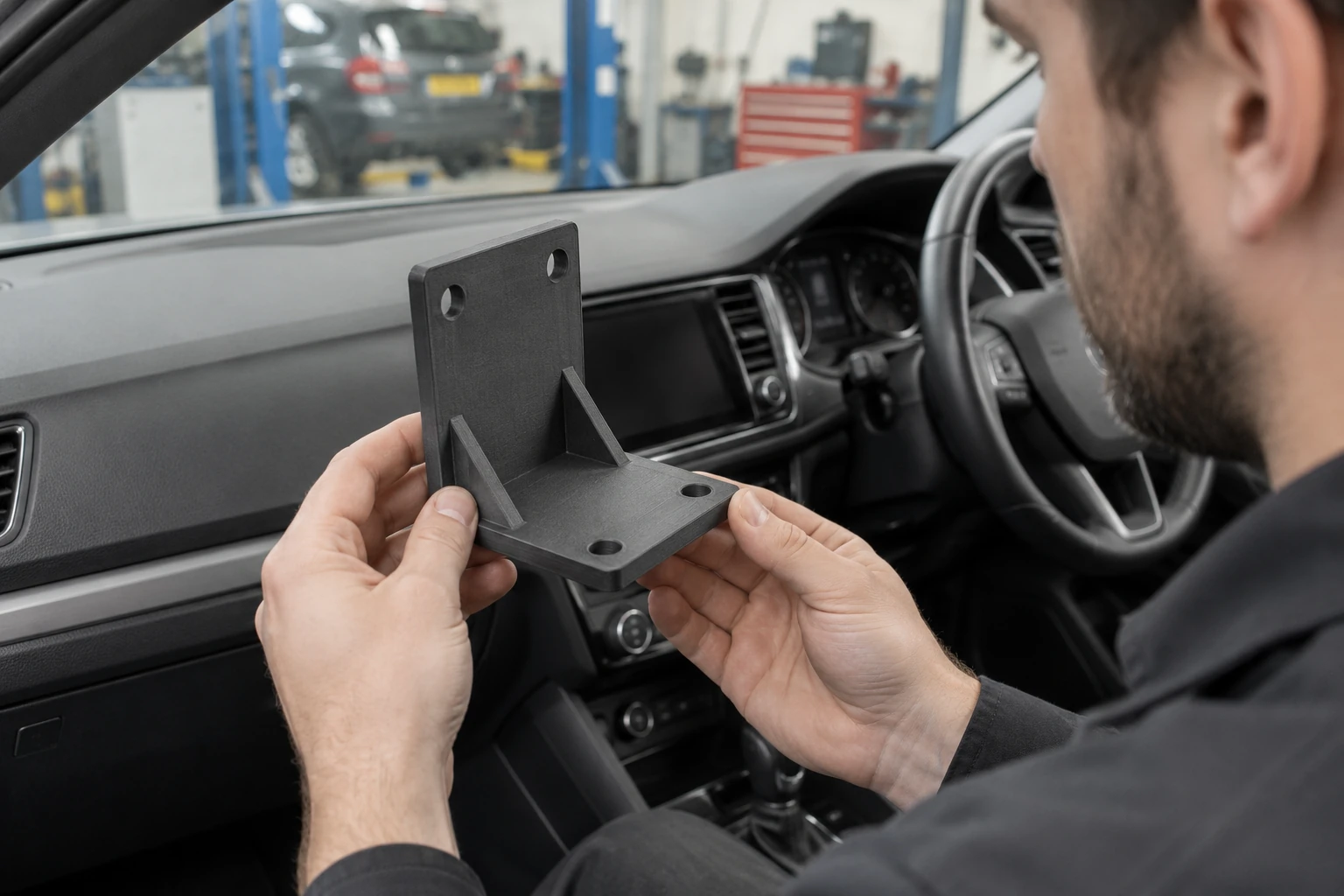
Match the actual part geometry and service conditions to the grade and test context, not just its family name.
ABS combines impact tolerance and useful heat resistance for indoor brackets, enclosures and workshop components.
Choose ABS for indoor functional parts where impact and moderate heat matter. Choose ASA instead when sustained sunlight and weathering dominate.
Published product specifications; HDT at 0.45 MPa. Mechanical values are published test-specimen results.
| Property | Representative value |
|---|---|
| Density | 1.05 g/cm³ |
| HDT · 0.45 MPa | 87°C |
| Tensile strength · XY | 33 ± 3 MPa |
| Young’s modulus · XY | 1.88 GPa |
| Impact strength · XY, unnotched | 39 ± 3.6 kJ/m² |
Published test-specimen data is for comparison only. Orientation, conditioning, processing and geometry can change finished-part performance. Heat-deflection temperature is a standardised test, not a continuous-use rating.
Practical reasons to choose or avoid this material for a specific part.